
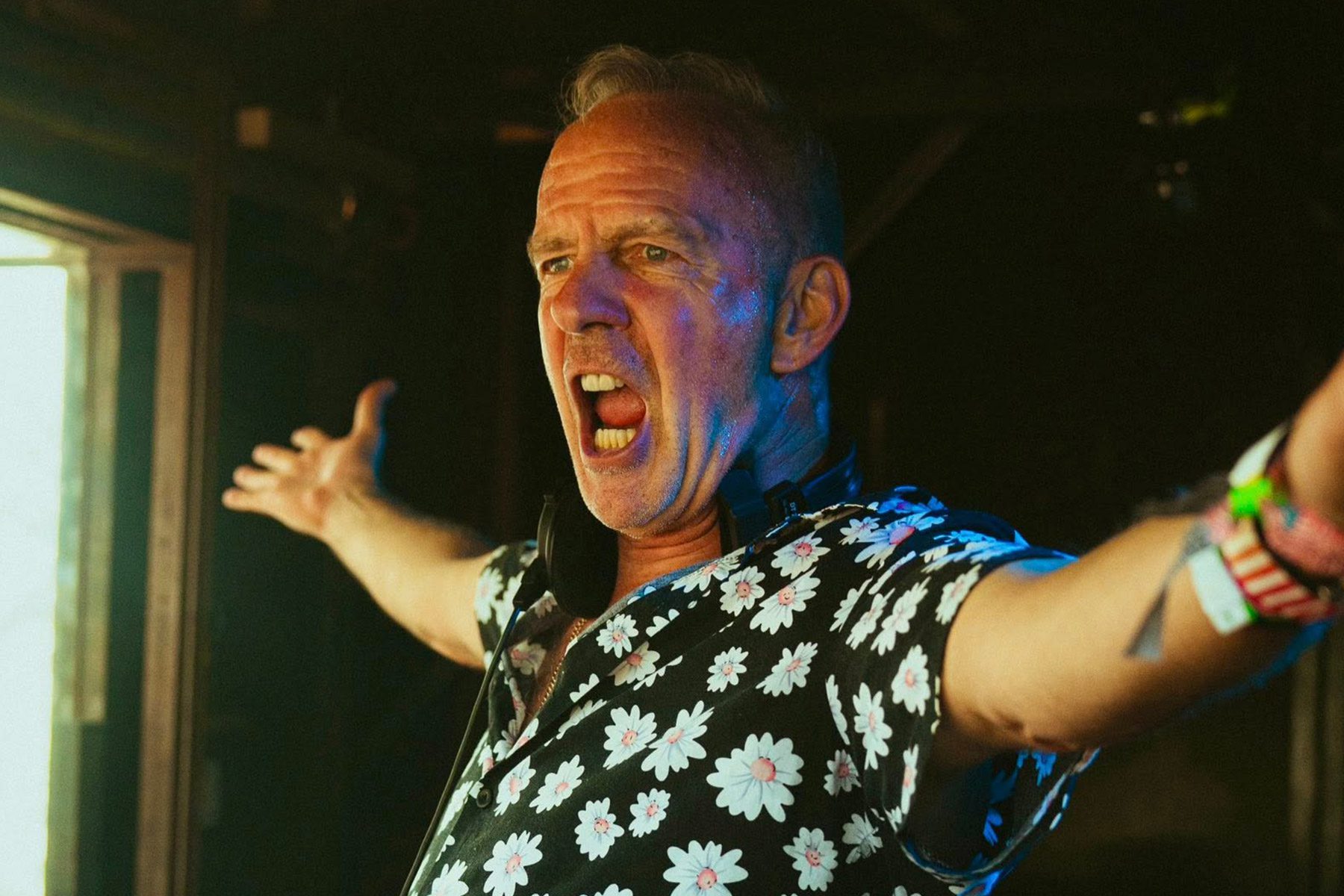
From the vast crowds of Big Beach Boutique to a 360-degree DJ booth at Quarters, Norman Cook is bringing the music back to a smaller room, with every ticket pound supporting the Brighton & Hove Albion Foundation.
Some artists build their legacies by making stages bigger. Others understand the power of returning to where the connection began.
On October 13 and 14, Fatboy Slim will take a different kind of spotlight in his hometown of Brighton. The British dance music icon, whose real name is Norman Cook, is set to perform two intimate club nights at Quarters, offering a rare opportunity to experience his unmistakable sound in a setting far removed from the enormous crowds that have defined some of his most famous performances.
The shows mark Cook’s first appearance at the venue, with all ticket proceeds going to the Brighton & Hove Albion FC Foundation. The October 13 date has already sold out, while tickets for the following night remain available.
It is a relatively small event in the calendar of an artist accustomed to playing on a much larger scale. Yet its appeal lies precisely in that contrast. For a DJ whose name is closely associated with landmark outdoor parties, festival crowds and the evolution of British big beat, the prospect of playing an intimate room offers a different kind of energy: closer, more immediate and rooted in the shared experience of the dance floor.
From Brighton Beach to the Club Floor
Fatboy Slim’s relationship with Brighton is inseparable from his musical identity. The city has long served as both home and creative backdrop for Cook, whose career helped bring electronic music to audiences well beyond the traditional club scene.
Few moments capture that relationship better than the Big Beach Boutique events. These celebrated gatherings transformed Brighton’s seafront into a vast dance floor, attracting crowds numbering in the hundreds of thousands and establishing a powerful connection between the city and large-scale electronic music culture.
Tracks such as Praise You, Right Here Right Now, The Rockafeller Skank and Sunset (Bird of Prey) became defining records of an era when dance music was increasingly moving into the mainstream without losing its connection to club culture. Their appeal extended beyond dedicated electronic music audiences, driven by instantly recognisable hooks, restless rhythms and Cook’s ability to turn sampling and repetition into something euphoric.
The Quarters shows offer a different perspective on that legacy. Instead of an expansive outdoor production, Cook will perform from a 360-degree DJ booth inside an arches venue on the Brighton seafront. The format brings the audience closer to the performance, shifting the focus away from sheer scale and towards the physical relationship between DJ, sound system and crowd.
For a performer whose career spans decades of changing dance music trends, the smaller setting also creates room for a more direct exchange with the audience. There is a particular pleasure in seeing an artist known for enormous events return to the intimacy of a club, where the music can be experienced without the distance that often comes with arena-sized productions.
The appeal is not nostalgia alone. It is a reminder that electronic music’s ability to bring people together does not depend on the size of the venue.
A Local Connection With a Wider Impact
The charitable purpose behind the two performances gives the event significance beyond its musical appeal.
Cook has been a long-standing ambassador for the Brighton & Hove Albion FC Foundation, maintaining an active relationship with the organisation through quiz nights, matchday appearances and performances for Albion Memories, its dementia support group.
His involvement reflects a form of public engagement that goes beyond attaching a famous name to a fundraising campaign. By using his profile and professional platform to support an organisation embedded in the community, Cook helps bring attention to work that reaches people across Sussex.
The Foundation supports more than 20,000 people each year through programmes spanning sport, education, inclusion and community wellbeing. Its activities include free weekly football sessions for more than 1,000 children, literacy and numeracy support in over 150 primary schools, and disability football provision that places it among the country’s leading organisations in that field.
These programmes illustrate how a football foundation can operate as more than an extension of a professional club. Through regular activities and local partnerships, such organisations can create opportunities for people who might otherwise face barriers to participation, learning or social connection.
The financial contribution from the Quarters shows is therefore connected to work with tangible local reach. Rather than making charity a secondary detail in the event announcement, the initiative places the Foundation at the centre of the occasion.
Cook has expressed his enthusiasm for the performances, describing them as an opportunity to support the organisation and highlight its work. The decision to direct all ticket proceeds towards the Foundation gives the nights a clear purpose while preserving the event’s identity as a genuine club experience.
In an industry where charitable announcements can sometimes feel detached from the music itself, this connection is particularly fitting. Dance floors are built around collective participation, and the same principle can extend beyond the venue when artists use their influence to support the communities they call home.
Quarters and Brighton’s Evolving Club Culture
The choice of venue adds another layer to the story.
Built on the site of the legendary Zap club, Quarters occupies a location with a meaningful place in Brighton’s nightlife history. The venue has quickly established itself as a notable new addition to the UK’s club landscape, operating under AMAAD and equipped with a bespoke L-Acoustics A15 surround sound system.
Its early programme has included Laurent Garnier, Shy FX and Chris Stassy, bringing together artists whose approaches to dance music reflect different generations and traditions. The Fatboy Slim dates continue that direction, placing a globally recognised name in a space designed around the immediacy of club culture.
The 360-degree booth is particularly suited to this kind of performance. By placing the DJ at the centre of the room, the arrangement can reduce the traditional separation between performer and audience, making the crowd an integral part of the visual and social experience.
The venue’s location also connects the event to Brighton’s longer relationship with underground music. The city has developed a reputation for a nightlife culture shaped by independent venues, adventurous programming and a strong sense of local identity. A club built on the site of a historically significant venue inevitably carries expectations, particularly when welcoming artists whose careers have helped define British dance music.
Quarters is still establishing its place within that history, but events like these give it an opportunity to connect past and present. Cook’s appearance brings a familiar name to a new space while reinforcing the enduring importance of smaller venues in an industry increasingly associated with large productions and destination events.
The distinction matters. Major shows can deliver spectacle on an extraordinary scale, but clubs offer a different kind of musical relationship. They allow DJs to work within the flow of a room, respond to the crowd and create an experience that feels specific to the night.
For an artist like Fatboy Slim, whose catalogue is so closely tied to communal release, that environment remains a natural fit.
A Busy Period for Norman Cook
The Brighton performances arrive during an active period for Cook. He recently DJed at the Royal Society of Chemistry and has expanded Better Living Through Chemistry, the project associated with his wider musical identity and career.
That continued activity underlines the longevity of an artist whose influence cannot be reduced to a handful of classic records. Cook emerged from a period of significant change in British dance music, helping translate the energy of club culture into a broader musical language that could travel across radio, festivals and public spaces.
His approach has always been grounded in the possibilities of DJing: finding connections between records, using samples creatively and understanding how music can change the atmosphere of a room. While the electronic music landscape has transformed considerably since his breakthrough years, those fundamentals remain central to the craft.
The Quarters shows offer a chance to encounter that history in a more immediate format. They are not framed as a large-scale retrospective or an attempt to recreate the spectacle of Big Beach Boutique. Instead, they place Cook in a club, where the music can stand on its own and the charitable contribution gives the occasion a wider meaning.
Both performances are scheduled to run from 21:30 to 02:00 and are restricted to audiences aged 18 and over.
The Value of Coming Back Smaller
There is a certain symmetry in Fatboy Slim returning to a Brighton club for an event designed to support the community around him. His career has included some of the biggest gatherings in British dance music, yet the fundamental appeal of his work has always rested on the same simple idea: people coming together through music.
At Quarters, that idea takes on a more intimate form. The crowd will be smaller than the hundreds of thousands who attended his landmark beach events, but the experience need not be less significant. In a room where the DJ booth sits at the centre of the audience, connection becomes the main attraction rather than a by-product of spectacle.
The charitable purpose adds another dimension. Brighton has played a central role in Cook’s story, and these performances turn that relationship into direct support for an organisation working across the local community.
For electronic music, the moment is a reminder that an artist’s impact is not measured only by ticket sales, streaming figures or the scale of a production. It can also be found in the decision to return home, play a smaller room and use a familiar name to support work that matters beyond the dance floor.
Fatboy Slim has spent decades making enormous crowds move. At Quarters, the scale may be different, but the underlying principle remains the same: music is at its best when it brings people together.