

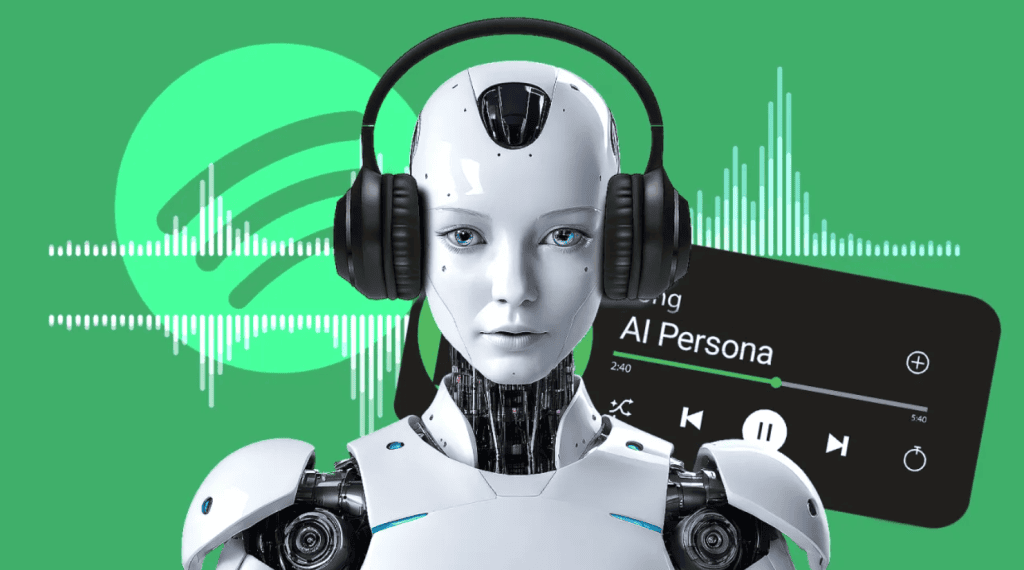
Spotify AI artist labeling is about to become a visible part of the streaming experience. Starting in mid-September, Spotify will introduce an “AI Persona” badge for selected artist profiles, search results, and track listings, while also changing how those profiles appear in editorial and algorithmic recommendations.
The move represents one of the platform’s clearest attempts yet to distinguish synthetic artist identities from human musicians. It also arrives as the music industry confronts growing concerns around AI-generated music, streaming fraud, and the impact of synthetic content on working artists.
Spotify AI Artist Labeling Will Identify Synthetic Personas
Spotify’s new AI Persona badge is designed to address a specific problem: listeners may encounter an artist profile that appears to represent a real musician when the identity behind it is entirely computer-generated.
The new visual marker will appear on selected profiles, search results, and track rows beginning in September. According to Spotify, the system focuses on artist identities where elements such as the display name and profile imagery represent a fictional or AI-generated persona rather than an actual human artist.
For listeners, the change offers a straightforward form of transparency. Instead of having to investigate an unfamiliar act independently, users will have a visible indication that the identity they are encountering is synthetic.
That distinction matters as AI-generated music becomes easier to produce and distribute at enormous scale.
How Spotify’s AI Persona System Will Work
Spotify is giving creators a way to voluntarily disclose that they operate an AI-generated persona through Spotify for Artists.
However, the platform will not rely entirely on self-reporting. Spotify says it will also review artist profiles and apply the badge when its criteria identify photorealistic, computer-generated personas across highly visited areas of the service.
This creates a two-part system: creators can disclose their status themselves, while Spotify retains the ability to identify and label profiles independently.
If Spotify’s review team manually applies an AI Persona badge, the affected creator will receive a notification. The company also plans to provide an appeals process for artists who believe the designation has been applied incorrectly.
Later in 2026, Spotify plans to introduce another layer of oversight by allowing listeners to report accounts they believe may warrant review.
What The AI Artist Label Means For Recommendations
The most consequential part of the policy may not be the badge itself. It is what Spotify plans to do with labeled AI Personas.
By default, AI Persona profiles will be excluded from editorial and algorithmic playlists. They will also be removed from personalized recommendation feeds unless a listener has explicitly chosen to follow the relevant AI artist.
In other words, discovering an AI-generated artist will become more intentional.
A user who follows such an act can continue encountering its music. However, Spotify’s recommendation systems will not automatically place those artists alongside human musicians simply because listening behavior suggests they might fit a user’s taste.
That could significantly change how synthetic artists compete for attention on the platform.
Why Spotify Is Targeting AI-Generated Artist Identities
The policy comes as streaming platforms face a rapidly expanding volume of machine-generated music.
AI music tools can now produce complete tracks from relatively simple prompts, dramatically lowering the barrier to creating and distributing music. While that technology can be used creatively by legitimate musicians, it also creates opportunities for mass-uploaded content, impersonation, and manipulation of streaming systems.
The distinction between AI-assisted music and an AI artist identity is particularly important here.
Spotify’s new policy does not simply attempt to label every track that involved artificial intelligence during production. Instead, the AI Persona designation focuses on the identity being presented to listeners.
That means an artist who uses AI as part of a broader creative process is not automatically equivalent to a fictional artist profile generated entirely by machines.
AI Streaming Fraud Has Raised The Stakes
The economic implications extend beyond questions of artistic authenticity.
Spotify operates within a pro-rata royalty system in which a pool of subscription revenue is distributed according to overall streaming activity. As a result, fraudulent streams can divert money that would otherwise be allocated to legitimate rights holders.
The issue became especially visible after federal prosecutors charged a North Carolina man in a case involving AI-generated music and automated streaming activity. Authorities alleged that the scheme used AI tracks and bot farms to generate fraudulent plays and steal more than $10 million in streaming royalties.
Cases like this demonstrate why synthetic music is not merely a cultural debate. It can become a serious issue involving copyright, royalties, fraud, and the economics of professional music.
The Bigger Threat To Human Artists
Concerns about AI-generated music have also grown because synthetic content can be produced at a scale that individual musicians cannot easily match.
A study commissioned by the International Confederation of Societies of Authors and Composers (CISAC) and PMP Strategy estimated that AI-generated music could put billions of dollars in annual artist revenue at risk by 2028.
That projection reflects a broader concern: if listeners, recommendation algorithms, and streaming services become flooded with inexpensive synthetic content, human creators could face increasing competition for both attention and income.
Spotify’s recommendation changes attempt to address one part of that problem by ensuring that AI Personas do not automatically receive the same algorithmic exposure as artists building conventional music careers.
Spotify’s Policy Could Change How Music Discovery Works
Recommendation algorithms have become one of the most powerful gateways into modern music discovery. A listener does not need to search for an artist to encounter their music. Instead, playlists, personalized mixes, radio functions, and automated recommendations can introduce unfamiliar acts every day.
Removing AI Personas from those systems by default therefore has meaningful consequences.
For human artists, it could reduce the possibility that synthetic identities occupy recommendation space simply because they generate high volumes of compatible content. For Spotify, meanwhile, the policy creates a clearer distinction between passive algorithmic discovery and deliberate listener choice.
The approach also raises interesting questions about the future.
As AI-generated music becomes increasingly sophisticated, platforms will need to determine how much transparency listeners deserve, how AI involvement should be disclosed, and where the boundary lies between creative technology and synthetic identity.
Transparency Could Become The New Battleground For AI Music
Spotify’s AI artist labeling policy is unlikely to settle the larger debate surrounding artificial intelligence and music. However, it establishes an important principle: listeners should know when an apparent artist identity is not actually a human musician.
The policy also recognizes that recommendation systems can amplify synthetic content in ways that individual users may not realize.
For artists, the changes could offer some protection from algorithmic competition created by fictional personas. For listeners, the AI Persona badge provides additional context before they decide whether to follow or stream an act.
Ultimately, Spotify is placing transparency at the center of its response to synthetic music. As AI continues to reshape how tracks are created, promoted, and consumed, knowing who, or what, is behind the music could become just as important as the music itself.