
Some records are made to be heard. Others are made to be entered.
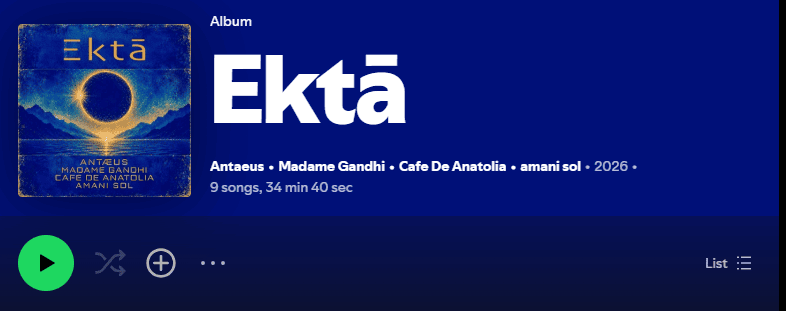
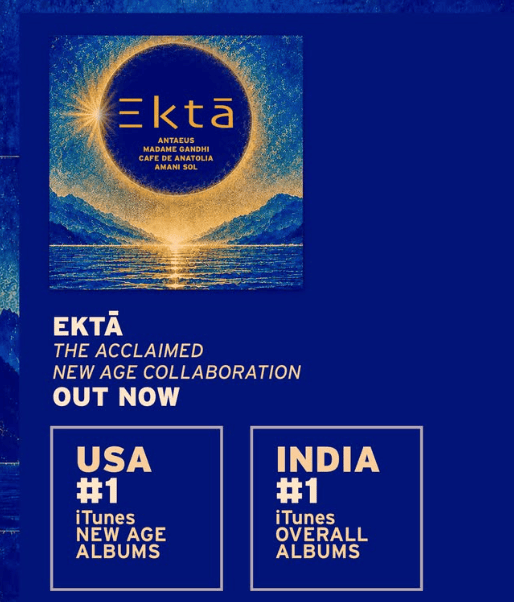
Ektā, the expansive collaborative album from Cafe De Anatolia, Antaeus, Madame Gandhi and Amani Sol, is already finding an audience far beyond the conventional electronic music ecosystem. Now out worldwide, the album has reached No. 1 on the iTunes New Age Albums chart in the United States and No. 1 overall on the iTunes Album chart in India — a striking early response to a project built around the idea of music without borders.
Released on August 14, 2026, Ektā moves between electronic production, ambient soundscapes, traditional instrumentation and contemplative vocals, but its ambition is larger than genre. At the heart of the record is its title: Ektā, meaning “oneness.”
It is a concept that runs through every layer of the album.
Rather than treating electronic music as a fixed cultural language, Ektā opens it outward — bringing Indian musical traditions into dialogue with Balkan voices, Middle Eastern instrumentation and contemporary electronic production. The result is not simply a fusion record. It is an attempt to create a shared sonic space where very different musical identities can exist together.
A No. 1 Moment for a Borderless Sound
The early chart success of Ektā is particularly revealing because the album does not follow the usual blueprint for an electronic release.
There is no dependence on a festival-ready anthem or peak-time club record. Instead, its music is deliberately spacious, atmospheric and introspective — qualities traditionally associated with ambient, new age and meditative listening.
Its No. 1 position on the iTunes New Age Albums chart in the United States places the project directly within that expanding culture of immersive listening, while reaching No. 1 overall among iTunes albums in India gives the record an especially meaningful connection to one of the cultural traditions that informs its sound.
The numbers matter, but perhaps more interesting is what they suggest.
There is an audience for electronic music that does not necessarily want more intensity.
It wants depth.
When Electronic Music Stops Chasing the Dancefloor
Electronic music has always contained a quieter dimension. Beneath the clubs, festivals and massive sound systems exists an equally rich tradition of music designed to create atmosphere, introspection and altered states of attention.
Ektā places itself firmly within that lineage.
Its compositions favor gradual movement over conventional drops, allowing electronic textures, acoustic instruments and vocals to develop organically. Ambient, downtempo, new age and organic electronic influences overlap without being forced into a single genre identity.
The effect is less like listening to a collection of tracks and more like entering an environment.
You do not necessarily listen to Ektā for a single moment of impact.
You let it surround you.
A Global Ensemble, One Sonic Language
The album’s international character is embedded in its creative DNA.
Antaeus, Nickarth, Billy Esteban and Amman Ahmed contribute to production, while Madame Gandhi, AleMor and East Balkan Noble Voices provide vocals. Around them is an extensive instrumental ensemble featuring sitar, esraj, dulcimer, nay, oud, duduk, tamboura, guitars, keyboards and violin.
What makes that combination compelling is that the traditional instruments are not treated as exotic decoration.
They are part of the architecture.
The sitar remains a sitar. Balkan vocal traditions retain their identity. Middle Eastern instruments bring their own histories into the composition. Electronic production simply creates a contemporary space in which those sounds can meet.
That is where Ektā becomes more than a “world music” experiment.
It becomes a conversation between musical cultures.
“Goddess Mantra”: Tradition in a Contemporary Frame
“Goddess Mantra” captures this philosophy particularly well.
The track brings together Madame Gandhi’s vocals and sitar performed by the Iasi Ensemble, incorporating an Indian-inspired rhythmic structure based around a 3/4 interpretation of taal.
Its power comes from the balance between tradition and technology.
The sitar is not reduced to a sample. The rhythmic language is not simply used as an aesthetic reference. Instead, these elements become structural components of a contemporary electronic composition.
The result feels hypnotic rather than theatrical — a track that seems to exist somewhere between ritual, meditation and modern production.
“Desert Night” and the Memory of Place
The album closes with “Desert Night,” featuring East Balkan Noble Voices and An Vedi on violin. The track introduces another layer of cultural memory and brings the album’s international dialogue toward its final destination.
By this point, Ektā has already moved across multiple musical worlds.
Yet the conclusion does not attempt to flatten those differences.
Instead, it allows them to coexist.
That is perhaps the most important distinction in the album’s philosophy: oneness does not mean sameness.
It means finding connection without erasing identity.
Beyond Cafe De Anatolia’s Organic House Legacy
For Cafe De Anatolia, Ektā represents an important expansion of an artistic language already associated with organic instrumentation, cinematic electronic production and global musical influences. But this time, the emphasis shifts away from the dancefloor and toward introspection.
The project arrives at a moment when the boundaries of electronic music are becoming increasingly fluid.
Organic House, ambient, downtempo, wellness music and immersive listening increasingly overlap. The listener no longer has to choose between a club record and a meditative soundtrack. Electronic music can occupy both worlds — sometimes within the same artist’s catalogue, and increasingly within the same listening session.
Ektā understands that evolution instinctively.
Its electronic foundation remains intact, but the purpose changes.
The music is not asking the listener to move faster.
It is asking the listener to listen differently.
A Collective Idea in an Individualistic Era
There is also something significant about the way the album was created.
Modern electronic music culture is heavily centered around individual artists and recognizable producer identities. Ektā deliberately pushes against that model. Its central creative force is collective, with different musicians, vocalists and producers contributing distinct cultural and artistic perspectives.
That makes the album’s title feel almost like a manifesto.
The individual does not disappear.
The individual becomes part of something larger.
A sitar can coexist with a synthesizer. A Balkan vocal can inhabit an electronic composition. Ancient musical traditions can enter a digital environment without being stripped of their character.
The album’s unity comes precisely from its diversity.
What Does Oneness Sound Like?
Perhaps that is the question Ektā leaves behind.
Not what does electronic music sound like?
Not what does New Age music sound like?
Not even what does world music sound like?
But what does oneness sound like?
The answer is not a single instrument or genre.
It is a dialogue.
A voice meeting a violin.
A sitar meeting a synthesizer.
Ancient musical memory meeting contemporary technology.
Different cultures occupying the same sonic space without competing for dominance.
That may also explain why the album’s early chart success feels significant. Reaching No. 1 in two very different contexts — the U.S. New Age chart and India’s overall iTunes album chart — reflects the unusual space Ektā occupies between electronic music, contemplative listening and global musical culture.
But the real achievement is not the chart position.
It is the possibility that a record built around slowing down can still create movement.
Not necessarily physical movement.
Something deeper.
Released into an electronic landscape increasingly obsessed with speed, scale and spectacle, Ektā makes a quieter proposition: that music can become more powerful when it creates room for different voices to exist at once.
And perhaps that is what its No. 1 moment represents most clearly.
The world does not always need another louder record.
Sometimes, it needs a record that reminds us how much we already have in common.
Ektā is out now — and its message is as simple as its title: different sounds can become one.